ARTICLE TEMPLATE

All submissions to the Journal of Halal Science, Industry, and Business (JHASIB) are evaluated through a structured editorial and peer-review process.
Initial Assessment. Each manuscript is screened by the Editor-in-Chief and the Editorial Board for scope fit, basic editorial requirements, and ethical considerations. Submissions are also screened for plagiarism using Turnitin.
Double-Blind Peer Review. Manuscripts that pass the initial screening are reviewed under a double-blind process in which the identities of both authors and reviewers are concealed. Every research article and review is evaluated by at least two independent external reviewers, selected on the basis of subject expertise. Reviewers must declare any conflict of interest before undertaking a review; where a conflict is identified, the manuscript is reassigned to another reviewer to maintain independence.
Editorial Decision and Revisions. The Editor-in-Chief makes the editorial decision in consultation with the Editorial Board, based on reviewer reports and the journal’s standards. Revised manuscripts are resubmitted through OJS and evaluated to confirm that required revisions have been addressed. Editorial meetings may be convened to support final decisions for each issue.
Submissions from Editors, Board Members, and Publisher Team. Research articles and reviews submitted by the Editor-in-Chief, members of the Editorial Board, or team of Research Synergy Foundation or The Halal Science Center, Chulalongkorn University, are subject to the same peer-review standards as all other submissions. Such manuscripts are handled by an independent editor who has no conflict of interest with the authors. The submitting author is excluded from all stages of the review and decision process and has no access to the review records. Where the Editor-in-Chief is an author, the editorial decision is made by a designated member of the Editorial Board.
Editorials written by the Editor-in-Chief or invited by the editors are not subject to external peer review but are reviewed by the editorial team before publication. Editorials do not report original research data and are clearly identified as “Editorial” in the published article.
Acceptance and Production. For accepted manuscripts, the Editor-in-Chief issues a Letter of Acceptance (LoA) confirming acceptance and the planned publication issue prior to publication. Accepted papers proceed to language editing and production, and are published according to the journal schedule.
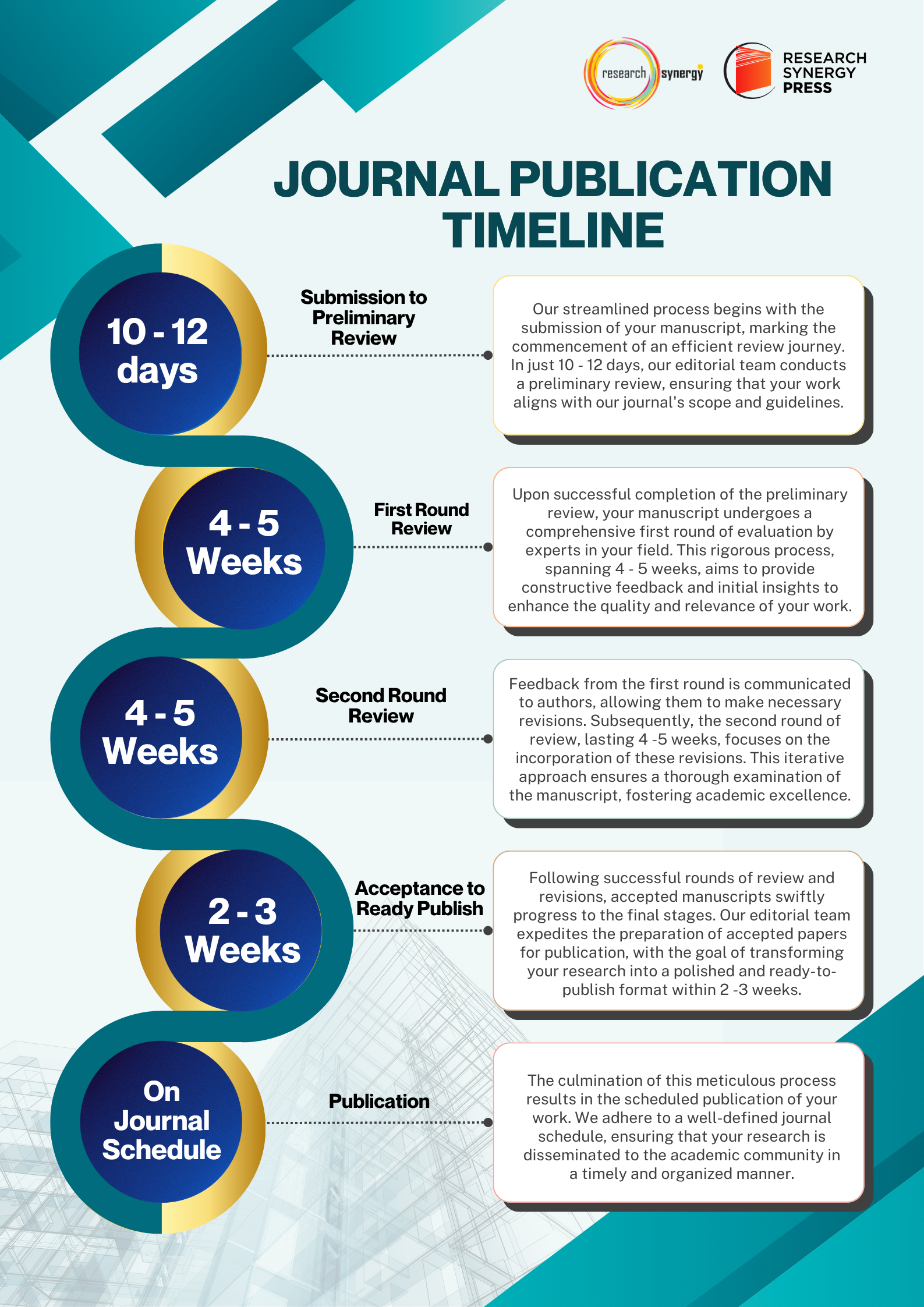
Welcome to our scientific journal's dedicated page on the review process timeline, where transparency and efficiency are at the forefront of our commitment to advancing scholarly research. From the initial submission to the publication of accepted manuscripts, we strive to provide a clear and concise overview of the various stages involved in bringing valuable contributions to the scientific community.
ARTICLE TEMPLATE
PEOPLE
POLICIES
SUBMISSION
JOURNAL METRIC
| Acceptance Rate : | 62 % |
| Review Speed : | 10 weeks |
| Issues Per Year : | 2 |
| Number of Volumes : | 4 |
| Number of Issues : | 7 |
| Number of Articles : | 45 |
| Number of Reviewers : | 7 |
| Number of Contributors : | 94 |
| Contributing Countries : | 13 |
| No.of Scopus Citations: | 28 |
| No.of Google Citations: | 175 |
| Google h-index : | 7 |
| Google i10-index : | 5 |
| UPDATE: October 2026 | |
Journal of Halal Science, Industry, and Business (JHASIB)
P-ISSN 2987-8535 | E-ISSN 3030-9689
Published by Research Synergy Foundation, Indonesia, in partnership with the Halal Science Center, Chulalongkorn University, Thailand
Editorial Office: Halal Science Center, Chulalongkorn University
Chulalongkorn Research Building, 11th – 13th Floor, 254 Phyathai Road, Pathumwan, Bangkok 10330, Thailand
Publisher Office: Research Synergy Foundation
Jalan Nyaman No. 31, Komplek Sinergi Antapani Bandung 40291 Indonesia
Email: [email protected]

This work is licensed under a Creative Commons Attribution-NonCommercial 4.0 International License.
